Laboratories
Laboratories
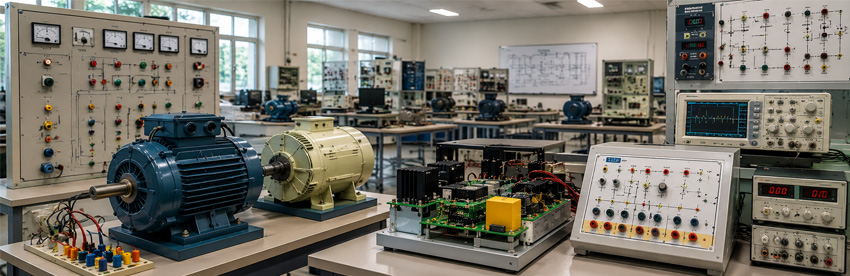
The Department of Electrical and Electronics Engineering maintains well-equipped laboratories that provide students with hands-on training and practical exposure to modern electrical systems, electronics, automation, and renewable energy technologies. These laboratories are designed to support academic learning, research activities, and industry-oriented experimentation, enabling students to bridge theoretical concepts with real-world engineering applications.
Electrical Machines Laboratory
Testing and performance analysis of DC and AC machines, transformers, generators, and induction motors.
Power Electronics Laboratory
Experiments on converters, inverters, rectifiers, choppers, and motor control circuits.
Control Systems Laboratory
Control system modeling, analysis, and simulation using MATLAB, Simulink, and hardware trainer kits.
Power System Simulation Laboratory
Software-based studies on load flow analysis, fault analysis, protection systems, and smart grid applications.
Electrical Circuits Laboratory
Practical sessions on circuit design, network analysis, measurement techniques, and troubleshooting.
Microprocessor & Microcontroller Laboratory
Hands-on training using 8051, PIC, Arduino, and embedded controller development platforms.
Renewable Energy Laboratory
Experiments involving solar photovoltaic systems, wind energy kits, battery storage, and hybrid energy systems.
Instrumentation Laboratory
Measurement and calibration using sensors, transducers, data acquisition systems, and signal conditioning devices.
All laboratories are equipped with high-speed internet connectivity, licensed simulation software, and modern industry-standard equipment. These facilities promote innovation, project-based learning, research, and practical skill development, preparing students for successful careers in the electrical, electronics, power, automation, and renewable energy sectors.